Visualization of Austin Animal Shelter Data
For this Introduction to Industrial Engineering assignment, our team developed four assertion-evidence slides using data from the Austin Animal Center, the largest no-kill animal shelter in the United States. The data was sourced from the City of Austin’s Open Data Initiative.
This data set contains numerical, categorical, datetime, and grouped data, each row corresponds with one animal entry into the shelter. The columns include:
• age_upon_outcome_(days) and age_upon_outcome_(years) (numerical)
• age_upon_outcome_age_group (categorical bin of age range)
• animal_id_outcome and animal_id_intake (alphanumeric identifier)
• date_of_birth, outcome_datetime, and intake_datetime (datetime)
• outcome_subtype, outcome_type, intake_type, intake_condition (categorical)
• sex_upon_outcome, sex_upon_intake (categorical)
• animal_type, breed, color (categorical)
• found_location (text/location string)
• age_upon_intake_(days) and age_upon_intake_(years) (numerical)
• age_upon_intake_age_group (categorical bin)
• time_in_shelter_days (numerical)
• time_in_shelter (duration/time delta)
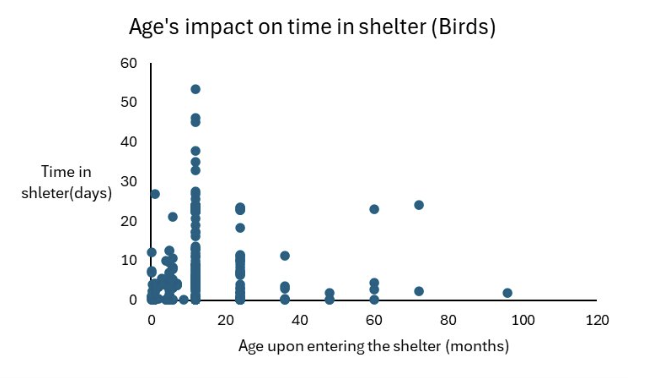
1. Bird Age vs Time in Shelter
Our group was asked to answer the question: Does bird age upon entering the shelter effect the time in days the spend in the shelter? This poses an interesting question because it could be thought about in multiple different ways for example someone might expect that the time in shelter for younger birds would be substantially less since owners want a bird that has its whole life left to live. Others might think that older birds will spend less time in the shelter since owners want a more mature bird that will take less attention to care for. To answer this question our group created a new column that converted the time upon entering the shelter (days) to time upon entering the shelter (months). This was done by dividing the age of the bird in days by 30.4167 since that is the average number of days in a month. After we created a pivot table that sorted the animal category to only show birds.
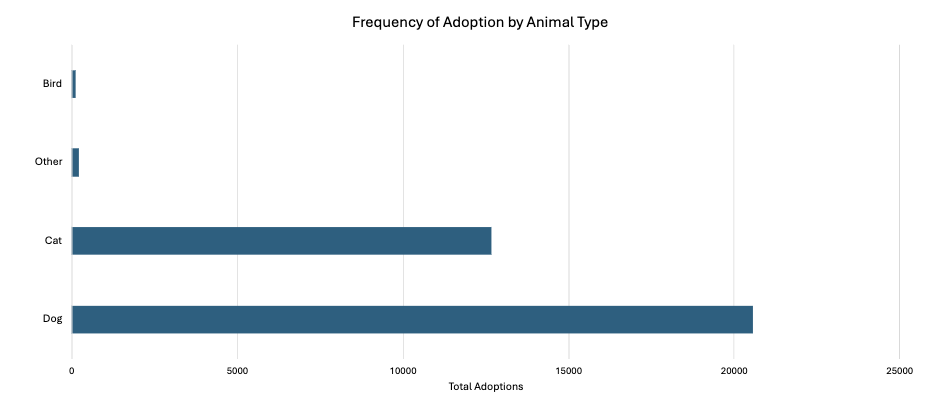
2. Frequency of Adoption by Animal Type
Our group was asked to answer the question: How do the frequency of adoptions differ between dogs, cats, birds and other? This was interesting to us because there is always the argument between whether dogs or cats are better and with answering this question we can find out which is more popular. Our conclusion, based on the bar chart it can be observed that there is a substantially greater number of dogs adopted compared to cats.
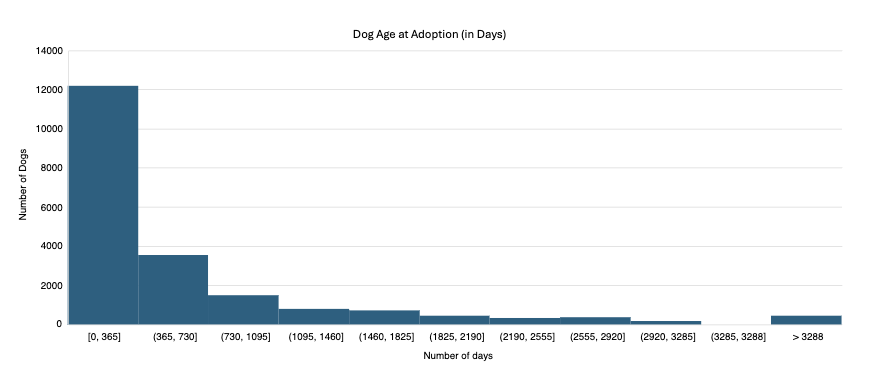
3. Dog Age at Time of Adoption
We looked at the distribution of dog ages at the time of adoption to understand whether people tend to adopt younger dogs more often, or if older dogs are just as likely to be chosen. This question is interesting because it can reveal public preferences and potential biases, which could help shelters improve how they market and care for dogs of different ages. results showed a clear pattern. The most common age for adopted dogs was between 50 and 60 days. The number of adoptions was highest at the younger ages, peaked in that 50–60 day window, and steadily declined to near zero as the dogs got older. This suggests that people strongly prefer to adopt very young dogs, and that interest in adoption drops off significantly as dogs age.
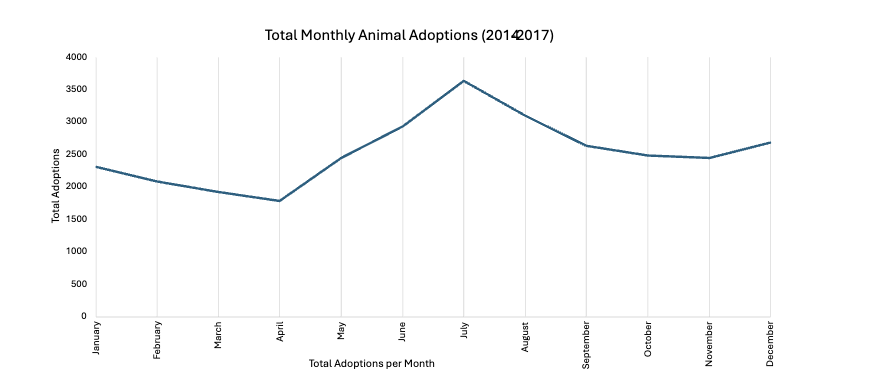
4. Seasonal Trends in Pet Adoption
Our group explored the question: is there a trend throughout the year showing a more popular time to adopt a pet? This is a compelling topic because it can help shelters better prepare for seasonal changes in adoption rates and plan resources accordingly. The final plot showed a clear seasonal trend. There was a noticeable spike in the summer, with June, July, and August standing out as the months with the most adoptions. This suggests that summer is the most popular time of year to adopt a pet.